
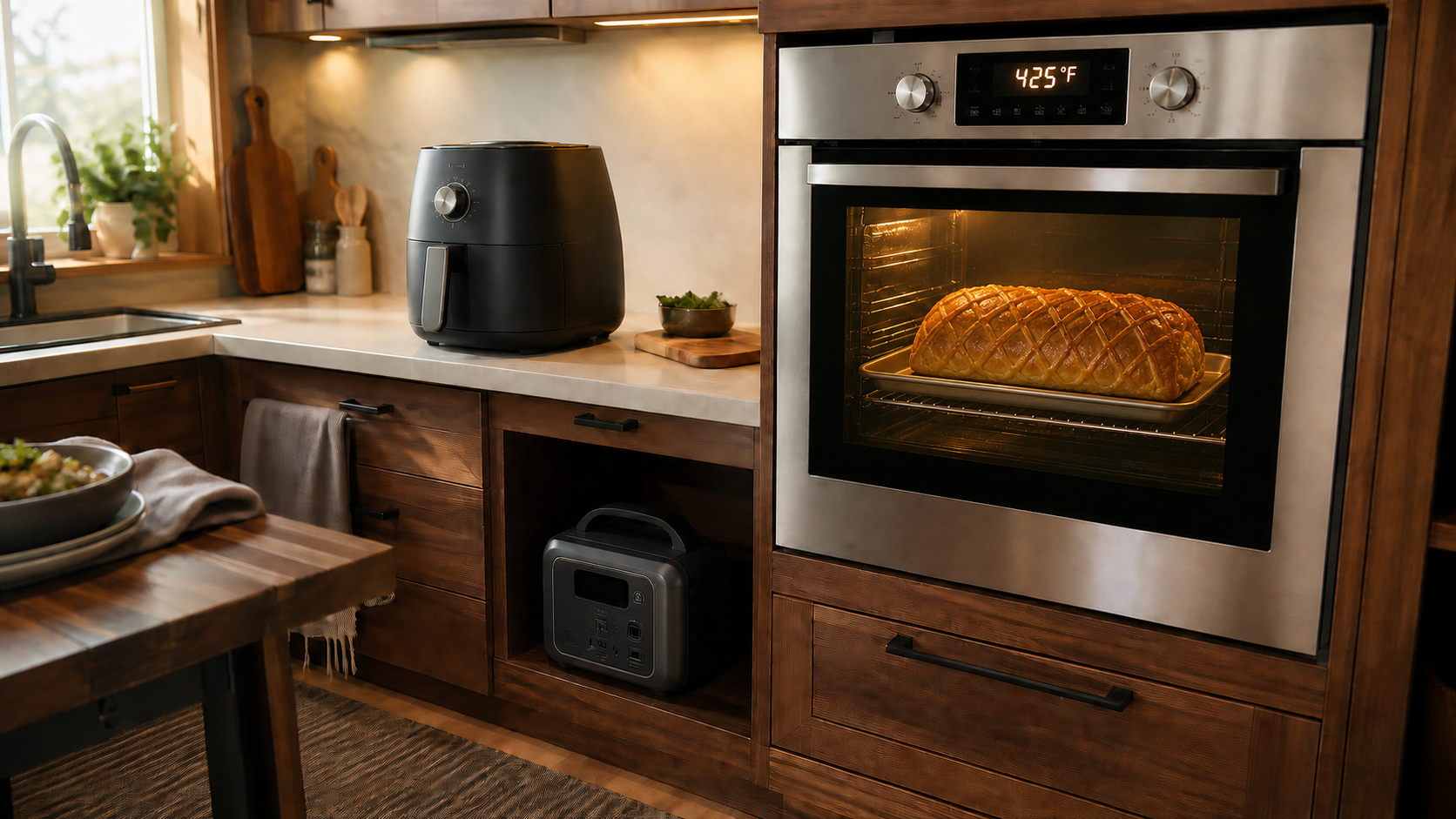
Is an air fryer cheaper than an oven? For 1 basket of food, usually yes. The smaller chamber heats quickly and stops sooner. The answer changes when potatoes need a second basket and dinner turns into a relay race.
The verdict up front: use the air fryer for 1 load. Compare real cook times at 2 loads. By the third cycle, a full electric oven can cost less because 1 preheat cooks the whole meal. Basket area, food type, oven fuel, and your utility rate move the crossover.
The latest U.S. Energy Information Administration figure available is 18.34 cents per kilowatt-hour for June 2026. EIA marks 2026 values as preliminary, and your own bill remains the better number.
1. How much electricity does an air fryer use?
Air fryer power consumption depends on wattage and time:
watts ÷ 1,000 × hours = kilowatt-hours
kilowatt-hours × electricity rate = cooking cost
| Full-power example | Energy | Cost at 18.34¢/kWh |
|---|---|---|
| 1,500W for 20 minutes | 0.50 kWh | about 9¢ |
| 1,725W for 25 minutes | 0.72 kWh | about 13¢ |
| 1,800W for 30 minutes | 0.90 kWh | about 17¢ |
The 1,500W example matches the Ninja Crispi FN101, while the Cosori TurboBlaze is rated at 1,725W. These are conservative nameplate calculations, not measured recipe results. Heating elements cycle after reaching temperature, so a meter can show lower consumption. The table still explains the advantage: high wattage is inexpensive when the cook is short.
2. Batch count decides the break-even point
The number of plates tells you little. A wide basket may hold 4 salmon fillets in 1 layer but only enough uncrowded potatoes for 2 people.
Suppose a 1,725W air fryer runs 25 minutes per load. At the national rate, 1 full-power load costs about 13¢, 2 cost 26¢, and 3 cost 40¢. If an electric oven uses 2.0 kWh across preheat and cooking, that session costs about 37¢. That oven loses to 1 load and beats 3. The oven figure is an example, not a universal rating.
Energy Saving Trust laboratory testing found the same direction with food held constant: an air fryer used less energy for a small chicken portion, while an oven made more sense for larger batches.
3. The oven wins when you fill it
A half-empty oven is an expensive room for 1 chicken breast. A full oven spreads the preheat across protein, vegetables, and tomorrow’s lunch. It also avoids repeated batches while the first tray cools.
Gas ovens need different math because gas is billed in therms or another gas unit. Use both utility rates instead of forcing the electric formula onto a gas appliance.
4. Can a portable power station run an air fryer?
In a motorhome, camper van, or off-grid kitchen, inverter output matters before cost. A 1,500W air fryer running 20 minutes uses 500Wh at the outlet. At 85% inverter efficiency, the battery supplies about 590Wh. A 1,800W model running 30 minutes needs roughly 1,060Wh from the battery.
Check continuous AC output, usable watt-hours, inverter efficiency, and other loads sharing the circuit. At 120V, a 1,800W air fryer already draws 15A. A manufactured home on utility power uses the household cost formula; a battery-powered rig has to survive the demand first.
Who should skip the air fryer
An air fryer is hard to justify if you already batch cook in a full oven, cook only a few times each month, or need repeated loads for every dinner. Buying another appliance to save pennies creates a longer payback and another object on the counter.
If the small chamber solves a real weeknight problem, compare the best air fryers for small kitchens next. Count heated loads before quart labels. That is where the cheaper choice becomes visible.
Sources checked
- U.S. Energy Information Administration electricity prices
- Energy Saving Trust appliance comparison
- Ninja Crispi wattage and specifications
- Cosori TurboBlaze specifications
More field guides
Research the next purchase
Choose the room or problem you are working on next.
Browse all guides