
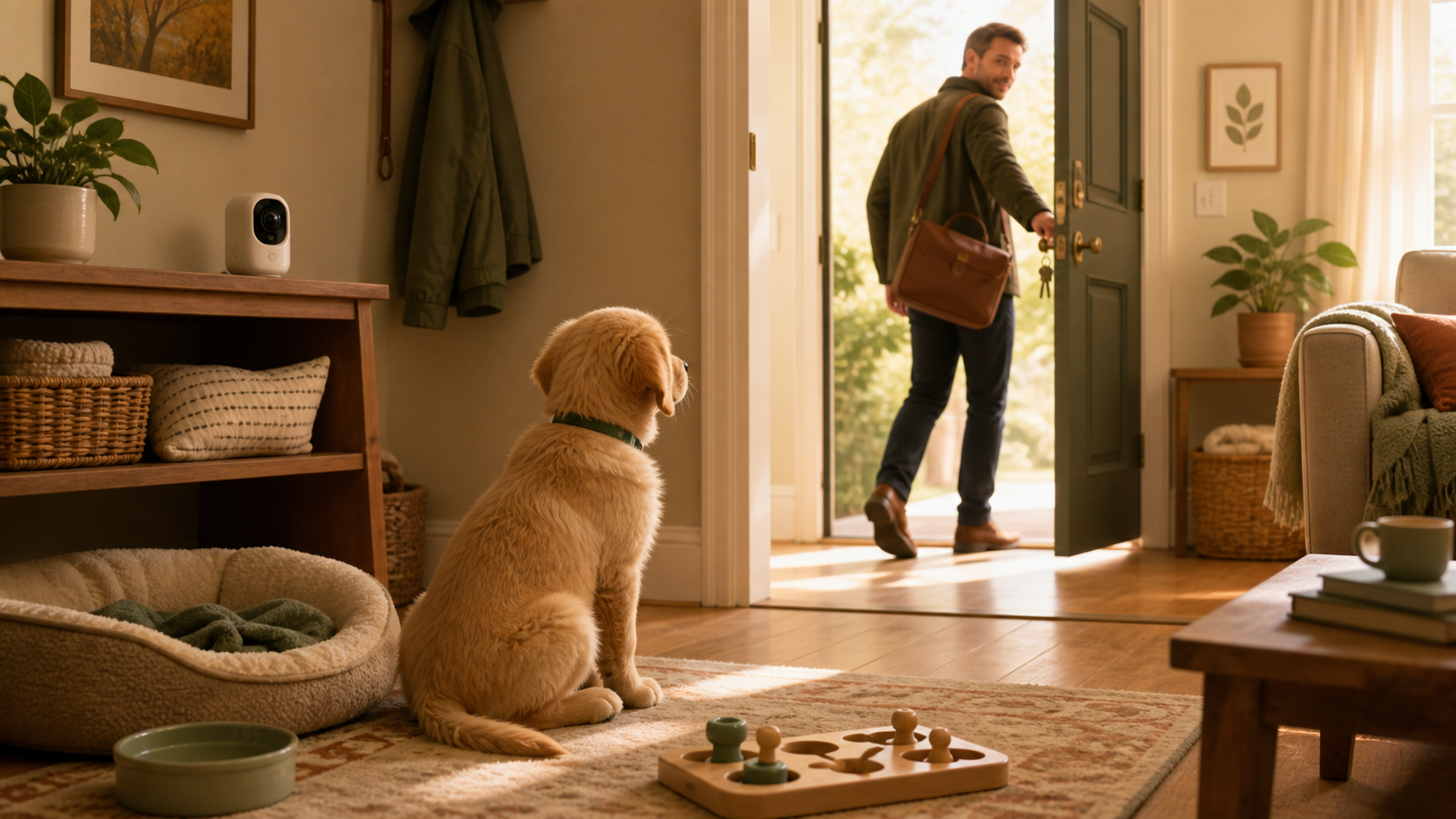
By Sunday night, the puppy has spent two days inside the orbit of the whole household. Breakfast ran long. The kids moved from room to room. The house had a presence providing company, excitement, treats, exercise, and affection.
Then Monday comes and brings early morning departures, or morning meetings that they aren’t allowed to interrupt. The school run starts. A college schedule shifts. A hybrid worker takes the train instead of walking into the spare bedroom. The puppy does not understand that everyone’s calendar changed. It only knows the house emptied.
September can sharpen the change when children return to school or someone begins a new semester, but the pattern repeats every week: concentrated company followed by a long, quiet stretch. The problem is not that your puppy failed to become independent. The household changed faster than the dog could understand it.
This is where puppy separation anxiety and an ordinary family schedule can become tangled together. A sudden absence creates a problem no camera or dispenser can solve on its own.
The verdict up front: practice short departures before the next long quiet stretch, arrange a real midday break on full workdays, and use a camera to learn what happens after the door closes. A treat dispenser can create one useful moment. A food puzzle can occupy another. Neither one teaches a puppy to feel safe alone.
How to prepare a puppy for a schedule change
Leave for a period your puppy can handle and return before the exercise becomes a crisis. The first useful departure may be shorter than the trip to the mailbox. That is fine. You are building a pattern: the door closes, the room stays safe, and the door opens again.
Keep departures boring. Put on the shoes, pick up the keys, leave, and come back without turning either side of the threshold into a ceremony. Emotional goodbyes only increase an animals separation anxiety. Practice on weekends as well as workdays so the puppy does not learn that a packed Monday morning always predicts a long disappearance.
A young puppy also needs a person in the middle of a long workday. Line up a sitter, walker, neighbor, relative, or trip home before the schedule changes. If the children are returning to school or a college timetable is about to empty the house, book that help before the first quiet Monday. A camera can show you that the puppy needs a break. It cannot open the door.
Use a camera as evidence
The useful question is not “Can I see my puppy?” It is “What does my puppy do after I leave?”
The eufy Indoor Cam E30 is a strong fit for that job because it can record continuously to a microSD card and track pets locally. The card is sold separately. Cloud storage remains optional.
For the differences between live viewing, local playback, and plan-gated features, see the full pet cameras without a subscription comparison.
Place the camera where it can see the sleeping area, water, and the path to the door. Review the first stretch after departure rather than refreshing the live view through every meeting. You are looking for a pattern: whether the puppy settles, wakes and resettles, or stays caught in pacing, vocalizing, scratching, or escape behavior.
Recorded history matters here. A live glimpse at 11:15 can miss what happened at 8:07.
Give the treat dispenser one job
The standalone Furbo 360 Dog Camera includes live view, two-way audio, barking alerts, and remote treat tossing without requiring the optional service. It does not offer local storage, and recorded video history is a separate feature.
That makes it useful when the goal is a remote check-in followed by one familiar cue and one treat. Test the sound and the toss while you are home. Some puppies run toward the machine. Others flinch at the mechanism or become more alert when a voice appears without a person.
If the device makes your puppy search the house for you, stop using the voice feature. Connection is only helpful when the dog experiences it as connection.
Practice food puzzles while you are still in the room
The KONG Wobbler turns dry food or small treats into a paw-and-nose game. It is easy to fill, unscrews for cleaning, and can slow a fast meal.
It is also not a chew toy. KONG instructs owners to supervise its use and remove it if damaged, which means it should not quietly migrate from “practice enrichment” to “object left with an unsupervised puppy all day.” Watch several complete sessions first. If the puppy attacks the plastic instead of moving it for food, choose a different activity.
The automatic pet toys comparison separates products that rest and restart from products that still require a person in the room.
The same rule applies to motorized balls and automatic launchers. Movement does not make a toy safe to leave alone.
Read the first week instead of grading it
One restless afternoon is information, not a diagnosis. Shorten the next practice, adjust the timing of exercise and the midday visit, and compare what the camera shows over several days.
Repeated distress deserves more than another gadget. If the puppy cannot settle, injures themselves trying to escape, stops eating when alone, or the pattern keeps getting worse, talk with your veterinarian and a qualified trainer who understands separation-related behavior. Video from the room can give them something more useful than a description assembled after a hard day.
The goal is not an independent puppy by Monday. It is a routine the dog can predict and the household can actually sustain. You leave. Someone returns. Needs get met in the middle. Over time, the empty house stops feeling like a disappearance and starts feeling like part of the day.
Puppy separation anxiety and schedule-change questions
How do I prepare a puppy to be alone after a schedule change?
Begin with short practice departures before the household routine changes, arrange midday care for long days, and record what happens after everyone leaves. Increase the time only when the puppy is settling rather than enduring escalating distress.
Can a pet camera help with puppy separation anxiety?
A camera can show when distress begins and whether the puppy settles, which makes it useful evidence for you, a trainer, or a veterinarian. Watching the behavior is not the same as changing it.
Can I leave a food puzzle with a puppy while I work?
Only after checking the manufacturer’s instructions and watching the puppy use it safely. The KONG Wobbler is explicitly a supervised toy, so it belongs in practice sessions rather than an unattended workday setup.
Sources checked
- eufy Indoor Cam E30 local-storage specifications
- Furbo features available on the standalone model
- KONG Wobbler instructions and supervision warning
- Today’s Veterinary Practice: approach to canine separation anxiety
- American Kennel Club: separation anxiety when returning to work
More field guides
Research the next purchase
Choose the room or problem you are working on next.
Browse all guides