
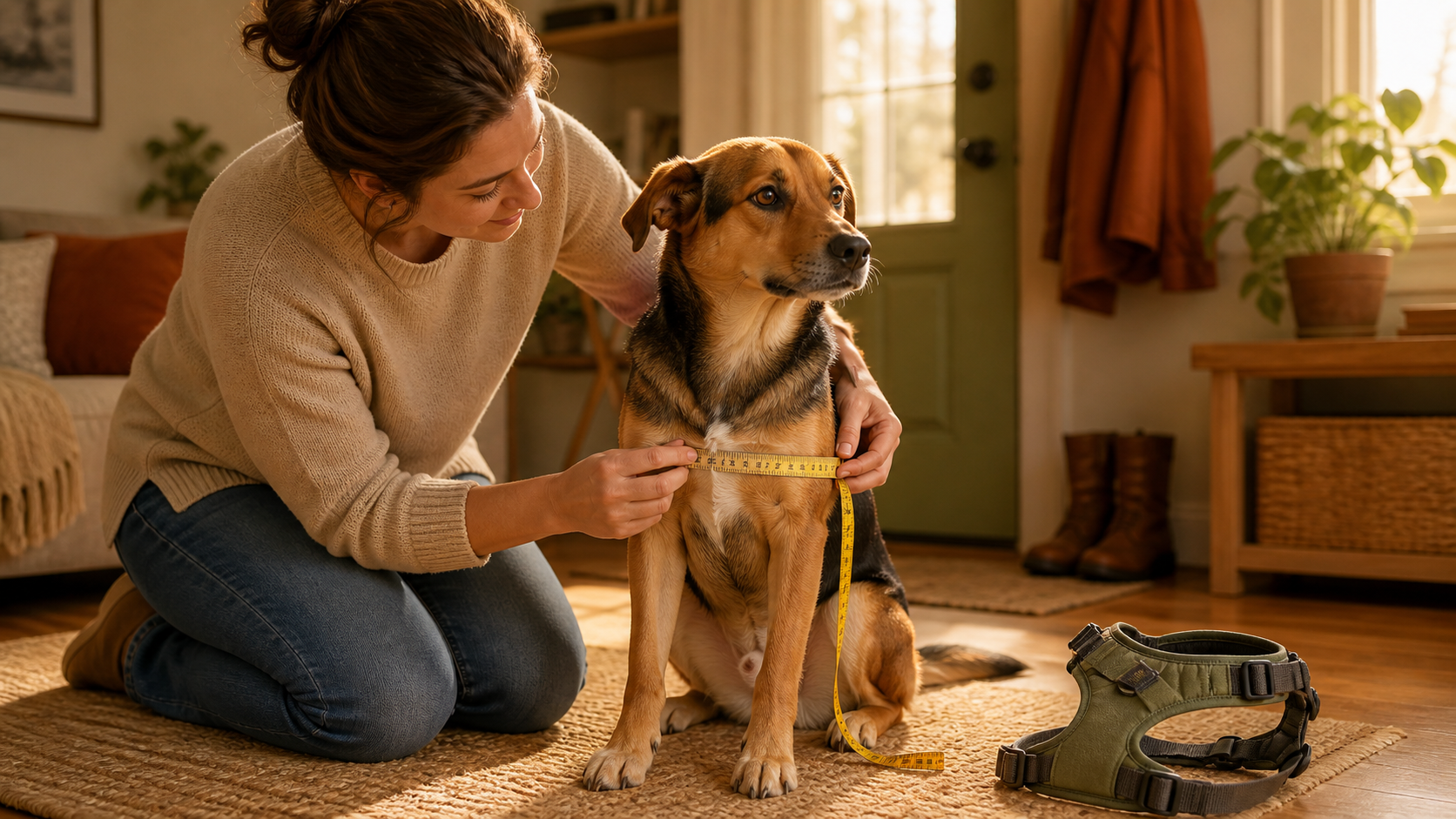
A harness can look perfect on the product page and turn into a rotating vest five minutes into the first walk. The dog leans toward a smell, the chest panel slips sideways, and the leash starts pulling from somewhere near the shoulder.
That is why “best no-pull harness” lists rarely agree. They begin with products when the useful answer begins with one measurement.
The verdict up front: measure around the widest part of your dog’s rib cage before choosing a harness. Use the manufacturer’s actual size chart, then test the neck opening, shoulder clearance, and hardware at home. “No-pull” is a leash-attachment location. It is not proof that the harness fits.
How to measure a dog for a harness
Run a soft tape around the deepest part of the rib cage, just behind the front legs. Keep the tape flat against the coat without cinching it down. Write the number down rather than trusting the size of the collar or the harness already in the drawer.
Then read the chart for the exact model. Small in one line can overlap medium in another, and a weight range cannot tell you whether your dog has a narrow neck, a deep chest, or a thick coat.
Ruffwear, for example, sizes its Front Range harness by rib-cage girth: 13–17 inches, 17–22, 22–27, 27–32, and 32–42. If your measurement sits on a boundary, Ruffwear says to choose the larger size. That is a real instruction. “Fits medium dogs” is not.
A good starting point still is not a universal answer
If your dog lands clearly inside one of those ranges, the Ruffwear Front Range harness is a defensible place to begin. Ruffwear publishes four adjustment points, an aluminum V-ring on the back, and reinforced webbing at the chest. The current Amazon listing also carries a large, strong review base.
Those details make it easier to evaluate. They do not make the harness right for every dog. The neck opening is not independently sized, and dogs with a narrow neck and broad rib cage can still land between the geometry of the product and the geometry of their body.
That is the distinction most recommendation lists flatten. Product quality matters. Fit decides whether you can use that quality.
Run three checks before the first real walk
1. Try the backward-pressure test
Clip the leash on indoors and apply gentle pressure in the direction a frightened dog might back away. Watch the neck opening. It should not travel over the head, fold into the throat, or give the dog an obvious escape route.
Do not turn this into a tug test. You are looking for movement, not trying to prove the stitching can survive a crisis.
2. Watch the shoulders from the side
The chest panel should stay centered while the front legs swing normally. If a strap rides into the armpit, crosses the moving part of the shoulder, or pulls the whole harness sideways when the leash tightens, adjustment may not solve the underlying shape mismatch.
Record ten seconds of an ordinary indoor walk. Video catches the slow drift that disappears when you look down only long enough to check a buckle.
3. Follow the force through the hardware
Trace the line from leash to dog. On the Front Range, the back connection is aluminum and the front connection is reinforced webbing. Other harnesses use different materials, which can be perfectly reasonable when the maker identifies them and explains how the load is carried.
Be wary when the listing spends paragraphs on padding but never names the attachment material, the buckle maker, or the adjustment range. Soft fabric photographs well. The connection points do the work.
Front clips manage a moment; they do not teach the walk
A front connection can redirect a dog who pulls and give the person holding the leash more control. It cannot teach loose-leash walking by itself. That part still comes from repetition, timing, and a routine both ends of the leash understand.
The same limit applies to durability. Remove the harness when the walk is over if your dog chews equipment, inspect the webbing and buckles regularly, and retire anything cut, cracked, stretched, or partly opened. “Rugged” does not mean chew-proof.
If your dog has slipped a harness before, lunges hard enough to hurt either of you, or has changed the way they move, bring in a qualified trainer or veterinarian. Better gear can improve the margin. It should not be asked to hide a training problem, fear response, or sore joint.
Measure first. Test the fit in the room where returns are still possible. The best harness is not the one that wins the list; it is the one that stays centered on the dog in front of you.
Dog harness fit questions
How tight should a dog harness be?
Two fingers between the harness and the dog are a useful starting check, but they are not the whole answer. The harness should stay centered, allow normal leg movement, and resist sliding over the head when you pull gently in different directions.
What if the dog is between harness sizes?
Follow the chart for the exact model rather than applying one rule to every brand. Ruffwear tells Front Range buyers to choose the larger size when the rib-cage measurement falls between its published ranges.
Does a front-clip harness stop a dog from pulling?
A front clip redirects the dog toward the person holding the leash, which can make a pull easier to manage. It does not teach loose-leash walking without practice and consistent handling.
Sources checked
- Ruffwear Front Range harness specifications and sizing
- Ruffwear Front Range adjustment guide
- American Kennel Club: choosing and fitting a dog harness
More field guides
Research the next purchase
Choose the room or problem you are working on next.
Browse all guides