
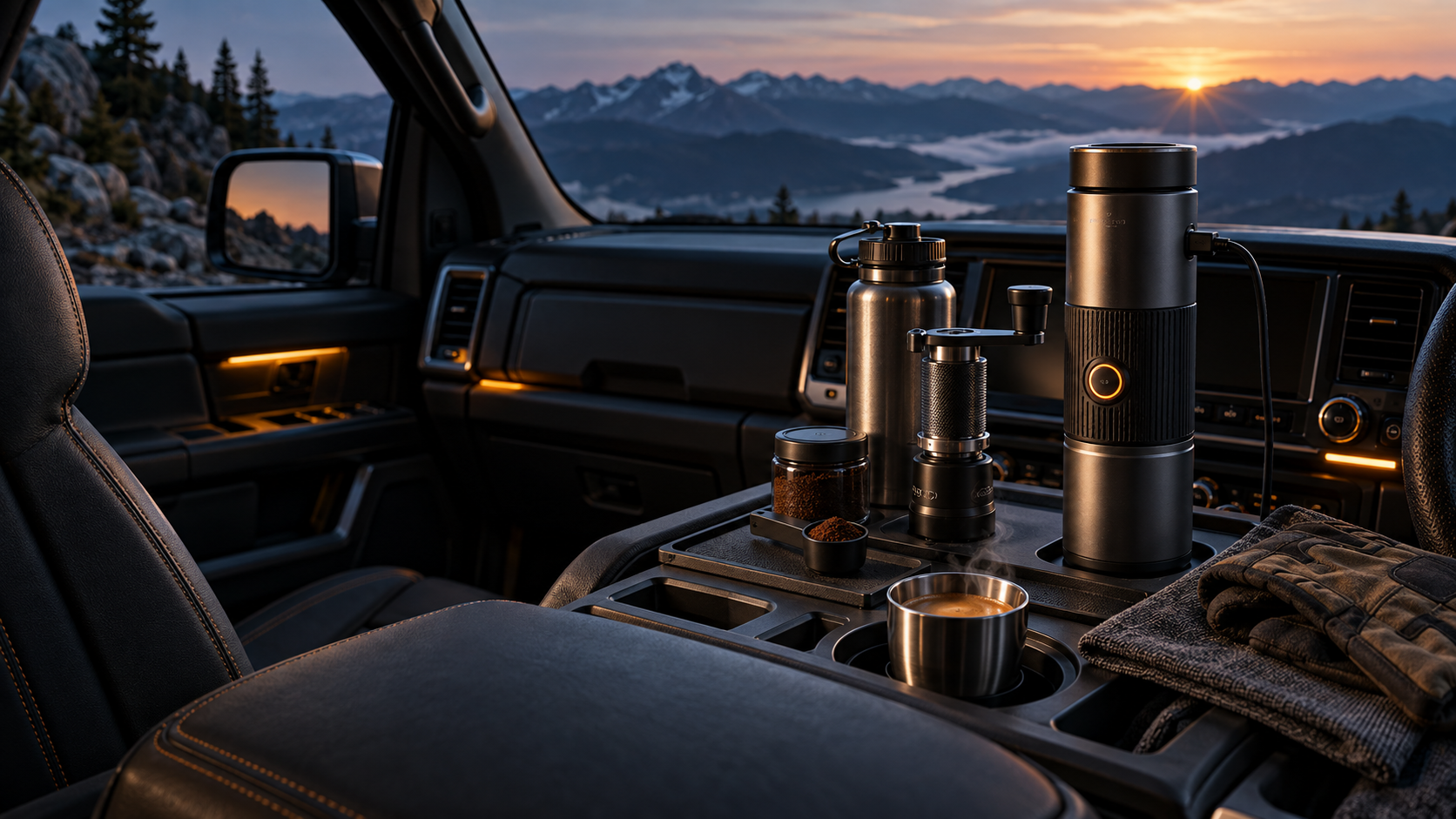
The car is parked. The nearest coffee is more detour than pleasure. This is where a mobile espresso maker earns its space: as a small routine for people who start work between places.
The verdict up front: carry hot water in an insulated bottle and pair it with a Wacaco Nanopresso if you want the simplest dependable setup. Choose an OutIn Nano when carrying hot water defeats the point. A 12V kettle can work, but its heat-up time makes it a specialist option, not the obvious default.
A 12V socket is not a kitchen outlet
A typical accessory socket cannot match a household kettle.
Streetwize, for example, says its 1-liter 12V kettle takes around 20 minutes to boil a full load. Its smaller kettle manual lists a 100-watt draw. Vehicle limits vary too: some Toyota models specify a 12V/120W outlet, while other vehicles use different ratings or switch the socket off with the ignition.
Read the kettle label and your vehicle manual before connecting anything. Do not assume the outlet supports the load, and do not build a coffee routine around draining the starter battery. Most important, every setup and pour happens while parked on level ground. Even the kettle manufacturer says not to use its product while driving.
The least complicated rig carries the heat
If you leave home or a campsite with hot water, an insulated bottle plus the Nanopresso avoids electrical guesswork. Wacaco says the brewer weighs 336 g, includes a cup, and needs no battery. Add hot water, an 8 g dose of ground coffee, and hand pressure.
This setup works for a commuter or field worker who can prepare water before leaving. Its weakness is timing. The bottle has to hold enough heat until the stop, and the Nanopresso’s standard pressurized basket favors convenience over the control of a larger open basket. The companion travel and camping guide explains that trade in more detail.
A self-heating brewer solves the missing-water problem
The OutIn Nano combines the heater, pump, cup, and battery in a bottle-shaped body that fits many car cupholders. OutIn says it accepts ground coffee and compatible capsules, heats room-temperature water in about 200 seconds, and can charge from suitable USB or 12V/24V car power.
The battery claim needs daylight. OutIn rates the Nano for up to 5 self-heated 50 ml brews per charge under its test conditions. Independent reviewers have reported between 2 and 4. Charge before the workday and treat any additional shots as margin, not a promise.
The Nano is the better fit when the day begins far from a kettle or the stop is too short for 12V heating. It is heavier than the manual setup, and every shot still leaves a wet basket or used capsule to store and clean later.
When a 12V kettle still makes sense
A car kettle belongs in a longer stationary routine: road-trip lunch stops, van travel, or field work where hot water also serves tea and food. Heat only what you need if the instructions allow it, secure the vessel, and unplug it before pouring.
For a brief commute, the arithmetic is poor. Carrying hot water is faster; a self-heating brewer is neater.
Who should skip a car espresso maker
Skip the category if you would handle it while moving, if coffee from home stays hot for the whole drive, or if any caffeinated drink will do. Instant coffee and a filled travel cup are less glamorous, but they ask less of the car and the morning.
Choose by where the heat comes from. Everything else is cupholder detail.
Sources
- Wacaco Nanopresso specifications
- OutIn Nano specifications and internal test notes
- Streetwize 12V kettle specifications
- Streetwize in-car kettle manual
- Toyota 12V/120W outlet example
- Coffee Chronicler portable espresso tests
- Brew Coffee Home OutIn Nano review
More field guides
Research the next purchase
Choose the room or problem you are working on next.
Browse all guides