
Search “best under-sink RO 2026” and the same smart systems wear the crown on list after list. Some rankings are careful. Some are built to move a click. The position tells you less than the paperwork behind each contaminant claim.
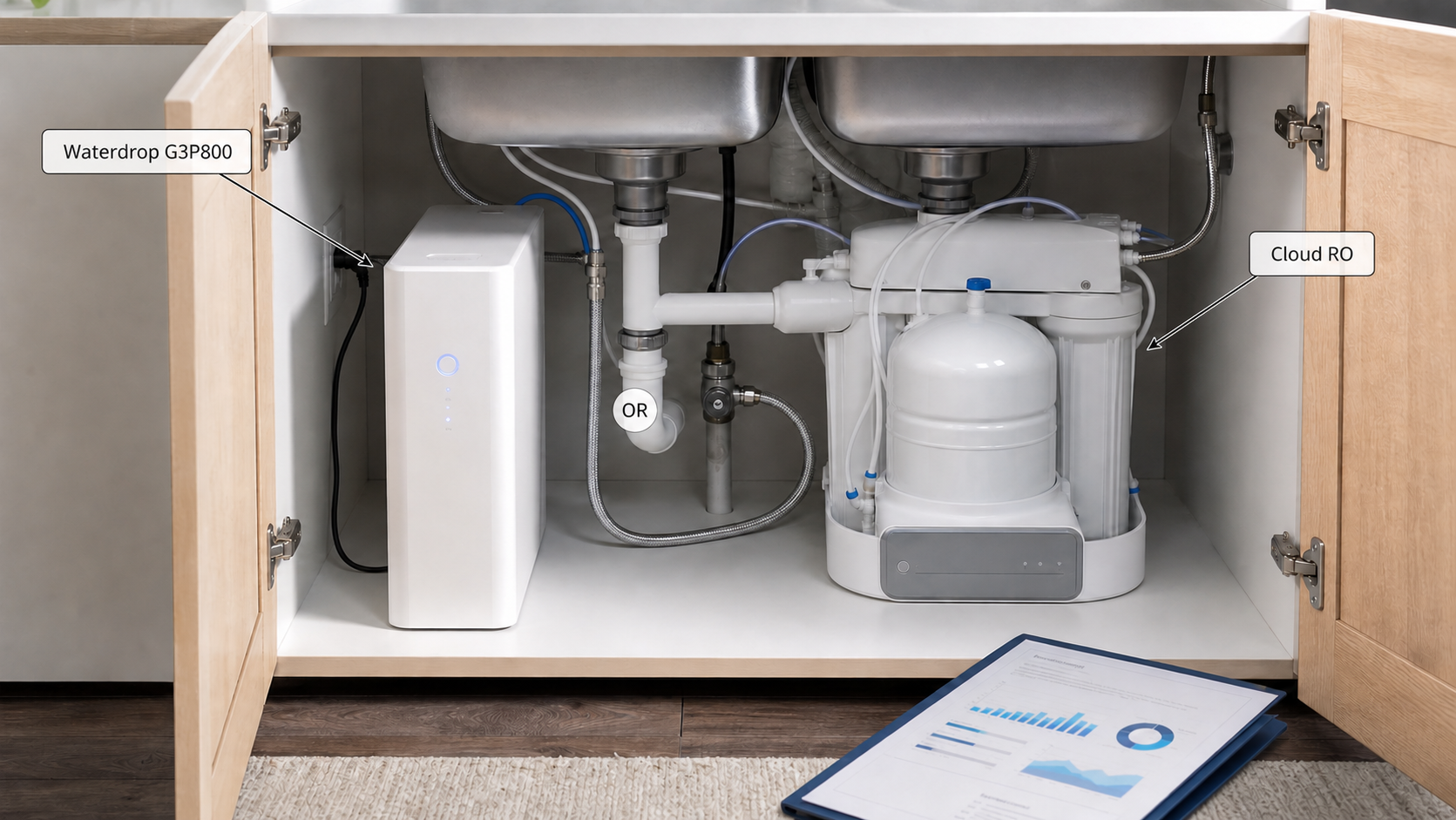
The verdict up front: choose the Waterdrop G3P800 if broader full-system certification and fast tankless flow matter most, especially when PFAS is the reason you are buying. Choose the Cloud RO if you need to avoid an outlet and value remineralized taste, a storage tank, and app monitoring. Cloud has meaningful third-party testing; it simply does not certify every claim in the same way. Buy the evidence, but read its label first.
1. What the certifications actually cover
This is the biggest lever, but it needs precise language. The G3P800 is certified by IAPMO R&T to NSF/ANSI 42, 53, and 58 for the claims listed in its performance data sheet, plus NSF/ANSI 372 for low-lead materials. That sheet reports certified reduction results for total PFAS, PFOA, PFOS, PFNA, PFHxS, and PFHpA, among other substances.
A separate Tap Score sample found none of the 14 PFAS compounds in its panel above the lab’s reporting limits after treatment. That is useful real-world evidence, but “not detected” in one filtered sample is not the same thing as a certification or proof that all 14 were present before treatment.
Cloud’s full system is NSF/ANSI 58 certified for TDS reduction, material safety, and structural integrity. Its performance sheet also reports SGS testing to NSF/ANSI 42, 53, and 58 methods for lead, PFOA, PFOS, and other contaminants. That testing matters. It is still different from having those specific reduction claims included in a product certification.
2. The outlet and the install
The G3P800 is tankless, rated at 800 gallons per day, and built for fast dispensing. It also needs power under the sink. Cloud uses a storage tank and a replaceable internal battery, so no outlet is required; the company says the battery lasts about 18 to 24 months and ships replacements with its filters.
Neither system avoids plumbing. Both need a cold-water connection, a dedicated faucet, and a drain connection. Waterdrop advertises a 3:1 purified-to-drain ratio. Cloud lists a 1:1 ratio. Those figures are test-condition claims, not promises for every home’s pressure, temperature, and water chemistry.
3. Noise and the quiet kitchen
The Waterdrop’s booster pump runs while it makes water, so a quiet cabinet and tubing that cannot vibrate against the wall matter. Cloud draws drinking water from a tank and uses an integrated permeate pump as the tank refills. That changes when you hear the system; it does not make the system silent. If your kitchen doubles as your office, install quality may matter more than either brand’s noise language.
4. Taste and remineralization
Cloud includes a remineralizing post-filter that adds calcium, magnesium, potassium, sodium, zinc, and trace minerals. The G3P800 does not remineralize in its standard configuration, though Waterdrop sells an add-on stage. That makes Cloud the simpler choice if you dislike the flat taste some people notice after RO. For coffee, neither mineral profile is automatically “better”; your beans, brew method, and starting water still decide that.
Who should skip most of this
Neither might be for you if you rent. Both normally require a faucet opening and a drain connection, and the standard drain saddle involves drilling the pipe. A countertop RO is the lower-risk route.
They are also hard to justify if your tap is already low in dissolved solids and passes a basic test. RO shines on a real contaminant problem, not on water that is already fine.
Neither pays off if you will not replace filters when required. Waterdrop lists six, 12, and 24-month intervals across its three cartridges. Cloud bases replacement alerts on usage and water quality, with roughly annual replacement for a typical family. Ignoring either schedule turns smart monitoring into decoration.
Rank these by the evidence behind the claim, not the position on a list. Buy the G3P800 for broader certified reduction claims and tankless speed. Buy Cloud for no outlet, built-in remineralization, and a different storage-and-monitoring experience. Neither gets to turn “tested,” “certified,” and “not detected” into synonyms.
Sources checked
- Waterdrop G3P800 product and certification summary
- Waterdrop G3P800 performance data sheet
- Cloud RO performance data sheet
- Independent G3P800 PFAS panel and test method
More field guides
Research the next purchase
Choose the room or problem you are working on next.
Browse all guides