
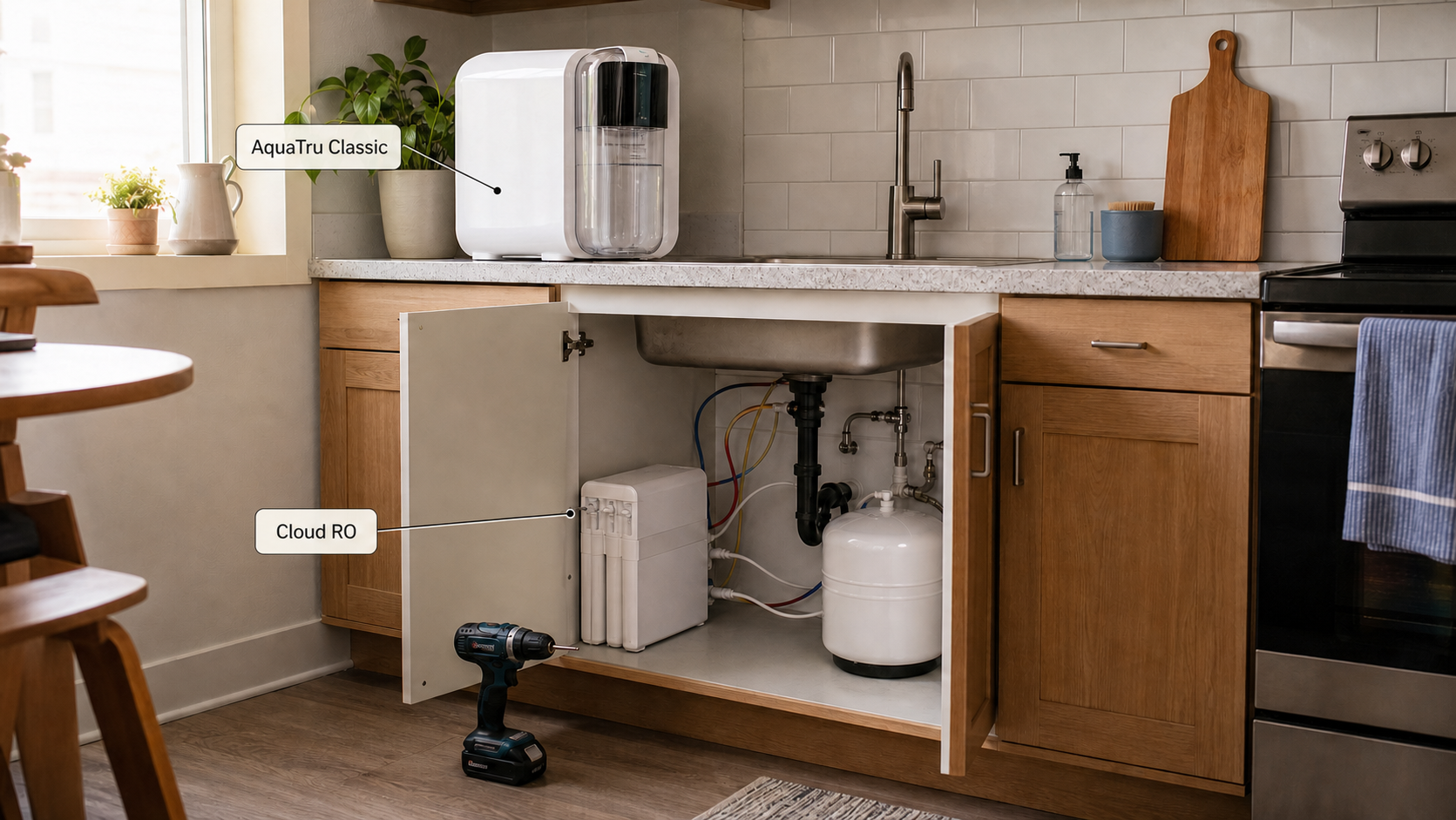
You want the bottled-water habit gone and cleaner water for your coffee, ice, or just for your loved one to have clean water to drink. Then the install guide says to drill the counter and tap the drain, and you can already see your deposit walking out the door. That fear is why many renters give up on reverse osmosis. Most of it is avoidable, but not by pretending a clamp makes a drilled pipe reversible.
The verdict up front: if you rent, default to a countertop system like the AquaTru Classic, which needs no drilling or plumbing. Go under-sink only if you can use an existing sprayer or soap-dispenser hole for the faucet and make the drain connection without altering the landlord’s original pipe. Get both choices approved in writing. Rank every option by what you would have to repair, not by how clean the finished cabinet looks.
1. The 2 steps most likely to put your deposit at risk
The first is drilling a dedicated faucet hole through the counter or sink. The second is the waste connection: a standard drain saddle still requires a hole in the drainpipe, even though the saddle itself clamps on. Those are the obvious permanent changes. Cabinet-mounting screws and altered shutoff hardware can matter too, depending on the lease and the kitchen.
Most feed-water adapters and tubing can be removed cleanly when installed correctly. That makes the useful question less “Can I install RO?” and more “Can I do it without changing anything my landlord owns?”
2. The countertop escape hatch
A countertop RO like the AquaTru sits on the counter, uses a refillable feed tank, and touches none of the plumbing. No faucet hole, drain line, or shutoff-valve adapter. You plug it in, fill it by hand, and take it to the next apartment in a box. AquaTru’s countertop models are certified by IAPMO to NSF/ANSI 42, 53, 58, 372, and 401 for the claims in their performance data sheet, so the simpler install does not mean thinner evidence.
The trade is visible counter space, an electrical outlet, and a tank you refill and empty. That is the honest cost of leaving the kitchen alone.
3. The least-invasive under-sink path
If you still want the tucked-away look, the Cloud RO removes one common obstacle: it runs on an internal battery, so it does not need an outlet under the sink. An existing sprayer, soap-dispenser, or plugged accessory hole can also spare the counter from drilling.
The drain is the catch. Cloud’s standard kit includes a waste drain saddle, and its installation still calls for a small hole in the drainpipe. Cloud says alternative adapters are available. For a rental, the cleaner approach is an approved compatible adapter or a removable replacement tailpiece that lets you reinstall the untouched original at move-out. Confirm the exact part with Cloud or a plumber before buying; do not assume any clamp-on saddle is drill-free.
Who should skip most of this
Own your place? This is the wrong optimization. The permanent faucet hole and a proper drain connection are the better install when nobody can hold a deposit over them, and a full tankless system becomes fair game.
It is also the wrong fight if your lease bans plumbing changes. Then a countertop unit is the clean answer, and an under-sink system is a conversation for renewal, not move-in.
None of this applies if you are moving in a few months. The setup and teardown outweigh the payoff over a short stay, and a good pitcher carries you to the next place.
One more honest note: permission to “install a filter” is too vague. Get the exact faucet and drain plan in writing, photograph the before state, and keep every original plug, sprayer, tailpiece, and fitting you replace. A friendly conversation is easy to forget at move-out. A signed description is not.
Rank these by what you would have to undo. The best renter RO is the one that leaves the kitchen exactly as you found it, and only after that does the filtered faucet matter.
Sources checked
More field guides
Research the next purchase
Choose the room or problem you are working on next.
Browse all guides