
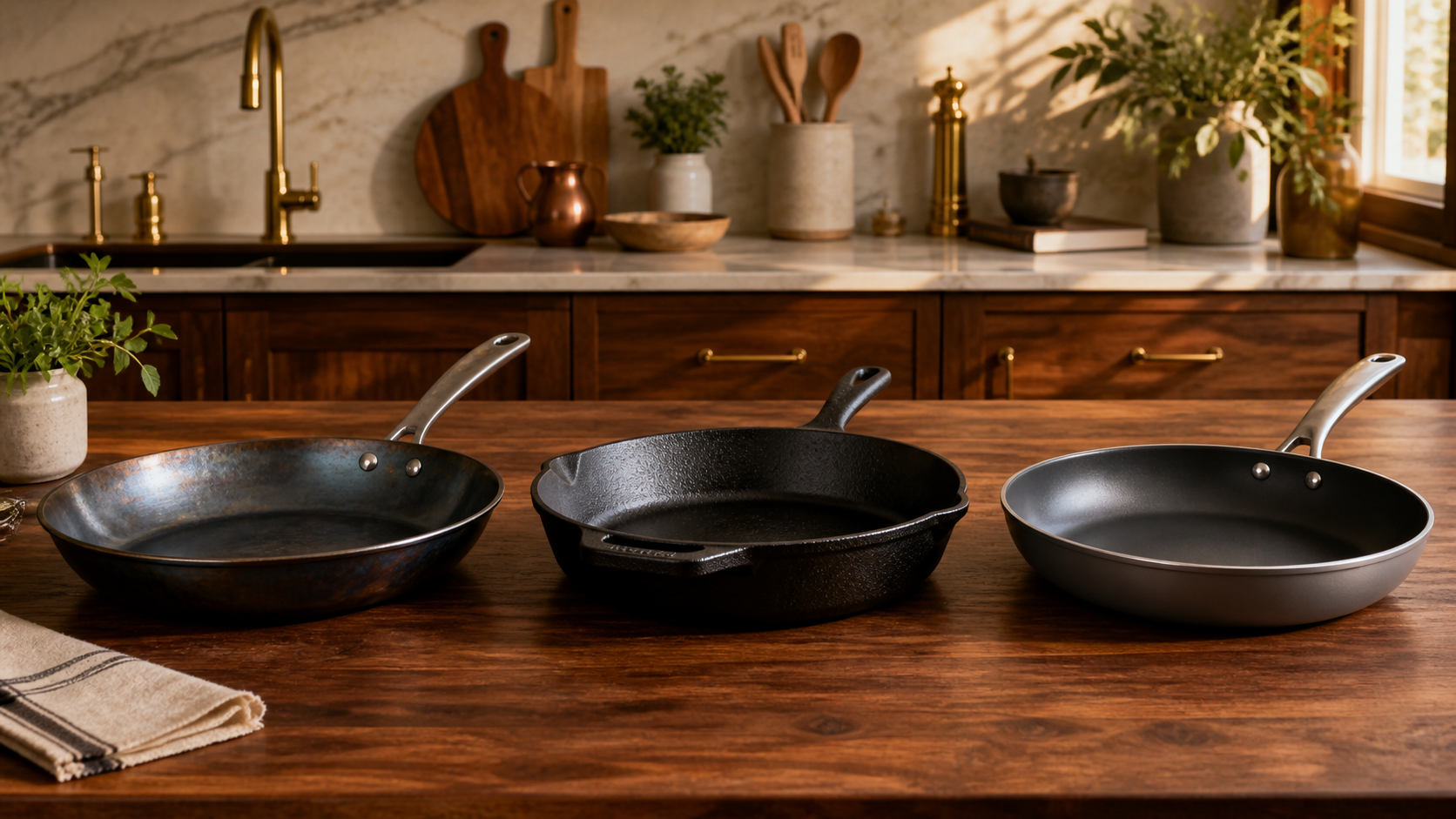
Most people buy a pan by its best promise, then resent it for its oldest weakness. Carbon steel rusts when it stays wet. Cast iron is heavy. Nonstick coatings wear. None of those facts automatically disqualifies a pan. They tell you what kind of relationship you are buying.
The short answer: choose carbon steel if you want one responsive, high-heat skillet and will dry it after washing. Choose cast iron if you value heat retention, oven use, and low cost more than easy handling. Choose nonstick if effortless release matters most and you accept that the cooking surface has a finite life. Most kitchens do not need one material to win every argument. They need one durable workhorse and, perhaps, one small nonstick pan for delicate food.
Carbon steel vs cast iron vs nonstick at a glance
| Factor | Carbon steel | Bare cast iron | Coated nonstick |
|---|---|---|---|
| Best at | Searing, sautéing, stir-frying, everyday skillet work | Hard searing, baking, frying, oven-to-table cooking | Eggs, fish, pancakes, low-effort breakfasts |
| Heat behavior | Usually faster to heat and respond | Slower to heat, strong heat retention | Depends on the metal beneath the coating |
| Handling | Often lighter, though thick pans can still be heavy | Heavy, with short handles and less leverage | Usually the lightest |
| Release | Improves with seasoning and technique | Improves with seasoning and technique | Excellent when new; declines with wear |
| Upkeep | Hand-wash, dry promptly, oil for storage | Hand-wash, dry promptly, oil for storage | Gentle tools, moderate heat, no empty preheating |
| Acidic food | Short cooks are possible; long simmers can strip seasoning | Same limitation until well seasoned | Usually nonreactive; follow the maker’s limits |
| Repairability | High: remove rust and re-season | High: remove rust and re-season | Low: replace when the coating is damaged or worn |
| Expected role | Daily high-heat workhorse | Heavy-duty specialist or budget workhorse | Convenience pan with a replacement cycle |
The important split is not simply “natural” versus “coated.” It is repairable versus replaceable. A neglected bare-metal pan can usually be restored at the sink. A worn coating cannot.
Carbon steel: the agile workhorse
Carbon steel is mostly iron with a small amount of carbon, much like cast iron, but it is formed from a thinner sheet. That construction usually makes it faster to heat, easier to maneuver, and more responsive when you lower the burner. Sloped sides also make it better for tossing vegetables and getting a spatula beneath an egg.
Its surface is not nonstick out of the box in the same sense as a coated pan. Oil, heat, and repeated cooking build seasoning: a thin, bonded layer that protects the steel and improves release. A mature surface can handle eggs, but heat control and a little cooking fat still matter. Carbon steel rewards technique; it does not erase it.
The upkeep is small but mandatory. Wash without soaking, dry the pan completely, and leave a whisper-thin coat of oil if it will sit for a while. Rust and damaged seasoning look dramatic, but both are repairable.
Buy carbon steel if: you cook several nights a week, sear often, want less bulk than cast iron, and do not mind drying a pan immediately.
Skip it if: you regularly simmer tomato or wine sauces, need true low-effort release, or know that damp cookware will sit in the sink overnight.
Ready to shop? See the best carbon steel pans.
Cast iron: mass, stability, and value
Cast iron changes temperature slowly. Give it time to preheat and its mass becomes an advantage: adding a cold steak or a batch of vegetables causes a smaller temperature drop than it would in many thinner pans. That stability helps with browning, shallow frying, and baking.
It is also simple. A basic skillet can move from burner to oven or grill, has no synthetic cooking-surface coating to wear out, and can survive generations of abuse. Cornbread, skillet cookies, roasted chicken, and deep searing all make sense here.
Weight is the cost. A large cast iron skillet can be awkward at the sink and punishing for anyone with limited wrist or shoulder strength. It also takes longer to respond when you reduce the heat. Like carbon steel, bare cast iron needs prompt drying and can lose seasoning during a long acidic simmer. Enameled cast iron solves the acid and rust problems, but it is a different tool: heavier, more expensive, and vulnerable to chipped enamel.
Buy cast iron if: you want maximum durability for the money, bake in a skillet, or care more about heat retention than nimble handling.
Skip it if: weight will keep you from using it or you want quick temperature changes.
Nonstick: convenience, honestly priced as temporary
Nonstick is a surface category, not one chemistry. Traditional PTFE coatings and ceramic-style coatings behave differently, and broad labels such as “non-toxic,” “PFOA-free,” or even a brand-wide “clean” claim do not tell you what is on a specific pan. If avoiding PFAS is important to you, look for a model-specific statement that the cooking surface is PFAS-free and PTFE-free. PFOA-free alone is not the same claim.
What coated pans do beautifully is remove friction from delicate cooking. Eggs, crepes, pancakes, and fish release with less technique and usually less fat. Cleanup is fast. For a rushed morning, that convenience is real.
The trade is lifespan. Release declines as a coating wears, and high heat, empty preheating, abrasive cleaners, and thermal shock can accelerate the process. Use low to medium heat unless the manufacturer says otherwise, use gentle utensils, and replace a pan whose coating is peeling, deeply scratched, or no longer performing. Some coated pans are oven-safe, but temperature limits vary by model and handle; check the actual instructions instead of assuming.
Buy nonstick if: eggs and delicate food are frequent, easy cleanup is the priority, or seasoning sounds like unpaid homework.
Skip it if: you want one pan for hard searing, broiling, metal-tool abuse, and decades of service.
Which pan cooks each food best?
| Food or task | Best default | Why |
|---|---|---|
| Steak and burgers | Carbon steel or cast iron | Both tolerate high heat; cast iron holds more heat, carbon steel handles more easily |
| Eggs and omelets | Nonstick | Reliable release with the least technique |
| Fish fillets | Nonstick or seasoned carbon steel | Nonstick is safer for fragile skin; carbon steel gives stronger browning |
| Cornbread and skillet desserts | Cast iron | Even oven heat and a stable, heavy base |
| Stir-fry and sautéed vegetables | Carbon steel | Faster response and sloped sides |
| Tomato sauce or wine reduction | Stainless or enameled cast iron | Long acidic cooks can weaken bare-metal seasoning |
| Campfire cooking | Cast iron or carbon steel | No delicate coating; choose based on weight and shape |
The maintenance test
Before buying, picture the pan after dinner—not in a studio photograph.
- Carbon steel and bare cast iron need to be dried promptly. A thin storage coat of oil is cheap insurance, especially in a humid kitchen.
- Nonstick needs moderate heat and gentle cleaning. Its easy daily care is balanced by eventual replacement.
- Enameled cast iron washes normally, but sudden temperature changes and hard impacts can damage the enamel.
This is the real decision. Bare metal asks for a small habit and gives you recoverability. A coating asks for gentler use and gives you immediate release. Neither is morally superior. One will simply fit your life better.
What about hybrid and copper pans?
Hybrid pans such as HexClad place raised stainless steel over recessed nonstick coating. Current HexClad products use the company’s PFAS-free TerraBond ceramic coating, while older reviews may describe a different formulation. That makes the model generation important. A hybrid can combine induction compatibility, browning, and easier cleanup, but it remains coated cookware; judge it by release, heat limits, warranty terms, and replacement risk—not by the steel pattern alone.
Copper solves a different problem. It responds to burner changes exceptionally quickly, which is useful for sauces, sugar work, and temperature-sensitive cooking. It is expensive and usually lined with tin or stainless steel. Copper belongs beside an everyday skillet, not in this three-way decision unless precise heat response is the reason you are shopping.
The two-pan answer
If you cook broadly, the honest answer is often two pans:
- Choose carbon steel plus a small nonstick pan if you want an agile workhorse and effortless eggs.
- Choose cast iron plus a small nonstick pan if you bake, sear, and care more about durability than weight.
- Choose carbon steel plus enameled cast iron if you want repairable high-heat cookware and a nonreactive pot for acidic or slow-cooked food.
My own useful split is carbon steel for daily cooking, cast iron when mass or baking matters, and one coated pan for mornings when technique is not the point. The goal is not a collection. It is fewer pans with clearer jobs.
Frequently asked questions
Is carbon steel better than cast iron?
It is more responsive and usually easier to handle. Cast iron retains heat better and often costs less. Carbon steel is the stronger everyday skillet for many cooks; cast iron is the stronger choice for baking, heavy searing, and maximum value.
Is carbon steel as nonstick as a coated pan?
No. Good seasoning, proper preheating, and cooking fat can produce excellent release, but a new coated pan is more forgiving. Carbon steel’s advantage is that its surface can be rebuilt.
Can soap touch carbon steel or cast iron?
Yes. A small amount of modern dish soap will not dissolve properly bonded seasoning. Long soaking, the dishwasher, incomplete drying, and aggressive scrubbing are the larger risks.
Which pan should a beginner buy?
Buy the one whose care you will actually perform. Carbon steel is a versatile first choice for an active cook. Cast iron is the budget durability choice. Nonstick is the low-friction choice.
Sources checked
- Serious Eats: carbon steel vs. cast iron
- de Buyer: carbon steel care and oven-use guidance
- Lodge: cleaning and caring for cast iron
- HexClad: TerraBond coating composition
- HexClad: heat and care guidance
- California Department of Toxic Substances Control: cookware chemical disclosures
Part of the Inevitable Ape cookware series. Compare the best carbon steel pans, then use the carbon steel seasoning and troubleshooting guide when your pan arrives.
More field guides
Research the next purchase
Choose the room or problem you are working on next.
Browse all guides